💭 Vakana Thinking
As I am using the Vakana.mg app heavily in recent days, my mind can’t stop thinking about vakana and beads in general; there’s so much to uncover.
When someone commented on my Reddit post that he wondered if beads came before language or not, it triggered a lot of crazy theories and questions within me. So let me take you on a special tour inside my mind today.
Beads are powerful in a way I’ve never imagined before. I recognize now that I might’ve never thought that way if not for learning computer science and putting my feet deep enough into the Memory Palace technique.
I’ve always thought great memorization is only for the elite or the chosen few. That an average guy like myself could never go beyond a certain memory limit and could never memorize a book from cover to cover in my entire life. It seems I was completely wrong. It is possible, and within reach of anybody. The only questions are just “what do I want to remember?” and “why would I do it?”. The questions shifted from the ability to memorize to the motivation to commit to it.
Memory Palace did a great job breaking two of my biases about humans in general:
- That our mind can’t intentionally store huge amounts of information, so some external storage is always needed.
- That writing is the only way to store and transmit huge amounts of data with high fidelity. Oral transmission seemed weaker and always ended up being like the Chinese Whispers game.
With Memory Palace in any of its many forms, both high-fidelity retention and storage of very large data can be done.
The link between computer science and beads was a revelation to me. It opened my mind to a broader perspective on the beads, and on the entire Malagasy culture and heritage. I started to see patterns emerging one by one, connecting seemingly unrelated dots.
In computer science, a program is a sequence of well-chosen instructions executed one by one in a defined order. A vakana chain is strangely similar.
It’s a sequence of information, intention or instructions, put in a specific order.
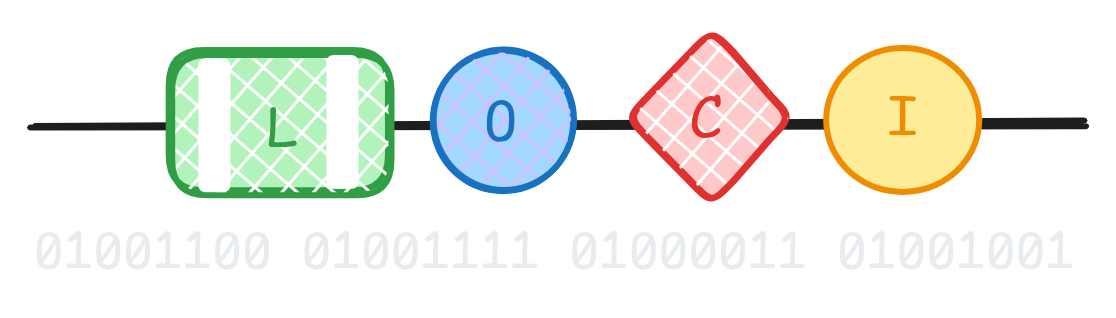
If traveled one by one, a well-charged sequence of vakana acts like a program. A program executed not by an external machine but by the mind.
By charged, I mean it the Memory Palace way: the bead’s meaning or name is made vivid and striking, even emotional or a little absurd, so it sticks instead of sliding off.
A program can be anything, from a game to a calendar to a calculator to more complex ones interacting with each other. It can also be a useless one or a harmful one.
It is the same for vakana chains. The difference lies not in how they’re executed, but in what they process, and in what runs the program.
In that regard, the vakana system’s input isn’t limited to tangible data and physical objects. It can also be qualities, or other non-material forms.
In other words, it could be used as a metacognitive or psychological tool too. I don’t pretend to know much about the mechanism behind prayer and meditation beads, but if I had to guess, this is a similar pattern. If someone wants to do some kind of programming into their own psyche, I suppose this is one obvious way. As long as the person knows (or has learned) the language of the beads, or is smart enough to invent their own, they can become very powerful.
And this might be part of why the Ombiasy, our great sages and shamans, were highly respected back then. They are the teachers, the masters and keepers of the system, the crafts and the languages. They are the equivalent of what the Software Engineers, Psychologists and Doctors could be in an era where computers, modern medicine, and modern psychology didn’t exist.
(And witches could be the black hat hackers of that time 😄.)
To answer the initial question, if ancient people used beads instead of language, I believe they could’ve built extremely complex things, wonders that we would never even think of. After all, beads can be made from organic materials like bones, wood, seeds etc. They don’t have to be gems or plastics. Which means they can degrade over time and leave nothing for archeology to find.
Vakana chains are highly versatile and practical if you think about it. They can be attached to almost anything. They can be worn on the body or fastened to various objects.
They can be woven through clothes, braided into the hair, hung on the wall, looped or clipped to some tools etc. Multiple physical programs, ready for execution.
When I think about how rich the Malagasy vakana vocabulary truly is (the way their names are encoded etc), I wonder what the heck our ancestors built back then, and how much of our heritage we lost over time because of ignorance, fear, and most of all prejudice.
P.S. Vakana.mg, the app, isn’t public yet; it’s still being built. If you’d like a heads-up when it opens, there’s a sign-up at vakana.mg.