Meet Alamino
3 min read
 Alamino
During the Meta Global AI Developer Hackathon, where I built Zotra, I met some really creative people from Madagascar. With Tendry and Tokiarivelo, we formed a team to take on another challenge: the PayPal AI Hackathon 2026.
Meet Alamino: a clearing house for market traders. The AI reads the debts. Plain code clears them. PayPal settles what is left.
- Video: the demo on YouTube
- Live demo: alamino.live-preprod.site (no install, no account)
- Source code: github.com/donovan-ratefison/alamino, under the Apache 2.0 license
It was a tough one. We had two days to deliver the code, the tests, the environments and the demo video. All that next to our daily work, our tasks and our meetings. We worked in parallel, often asynchronously, and far from each other.
Despite all that, we managed to cook something interesting.
What problem do we solve?
In a market, traders owe each other all day. The butcher owes the rice seller. The rice seller owes the restaurant. The restaurant owes the butcher. They write these debts in notebooks, and they settle each one by hand, in cash or by transfer.
No bank nets these debts for them. So far more money moves than necessary.
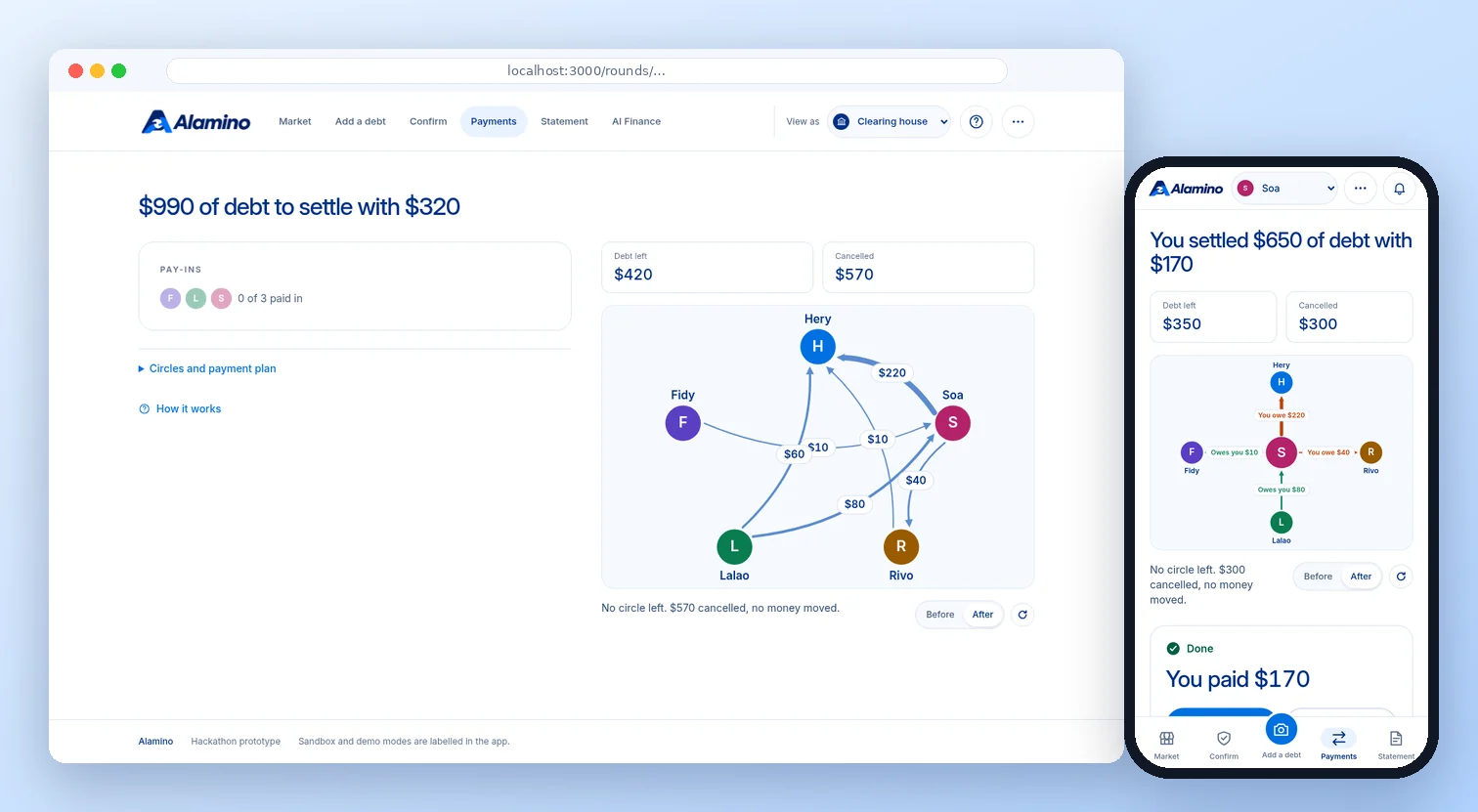
Alamino finds the debts that form circles and cancels them. No money moves for those. Then it settles only what is left: each trader pays once, or is paid once.
In the demo market, $990 of debt is settled by moving $320. That is 67.7% less cash.
 Alamino
- Add: a trader types a sentence (“I owe Hery 50 for rice”) or takes a photo of a notebook page. The AI turns it into a draft debt.
- Confirm: the debtor and the creditor both approve. If their amounts differ, the AI proposes a fix, and both sides still approve it.
- Clear: the engine cancels the debts that form circles. No money moves.
- Settle: traders who still owe pay in once through PayPal Checkout. One PayPal Payouts batch then pays the traders who are owed.
- Explain: each trader gets a plain-language statement: what cancelled, what is left, and why.
The same path works on a phone. The camera comes first, because a trader usually starts from a notebook. The ledger and the finance dashboard use AG Grid and AG Studio.
What is the AI allowed to do?
For us, this was critical. Debts are money, so we set strict rules on the AI, and we enforce them in plain code.
The AI can:
- read a sentence or a notebook photo and draft the debts;
- ask a question when a name or an amount is unclear;
- suggest a fix when two traders claim different amounts;
- write the sentences of each statement.
The AI cannot:
- compute or change an amount. Money math is plain, tested code.
- build a debt by itself. It returns only the other trader and the direction. The code builds the debtor and the creditor.
- save anything. Nothing is saved until a person clicks, and every AI answer is validated before use.
- confirm a debt. Both traders must approve it.
- put an amount in a statement. The amounts come from the engine.
On the payment side:
- The server never trusts an amount from the browser.
- A retry cannot pay twice: the round id is the payout batch id.
- No payout runs before every pay-in is captured.
- Without an AI key, a plain-code fallback takes over. Without PayPal keys, payments are simulated. The screen says so in both cases. The hosted demo runs this way.
In Zotra, the rule was: “The AI drafts. People decide.” We kept it here and added one more: the AI never touches the numbers.
Why “Alamino”?
Another little Malagasy lesson.
Alamino means “organize”, “sort out”, “arrange”, “put in order” or “settle”. For example:
- Alamino ny saina: “calm your mind”.
- Alamino ny efitranonao: “tidy up your room”.
The app settles the debts between traders. Hence the name.
This is the second dish from my cooking pot (see Toko), and this time I did not cook alone. Toko telo nahamasa-nahandro: it took three stones to cook this meal.