My way of handling knowledge (Emacs Carnival - The Search for Knowledge)
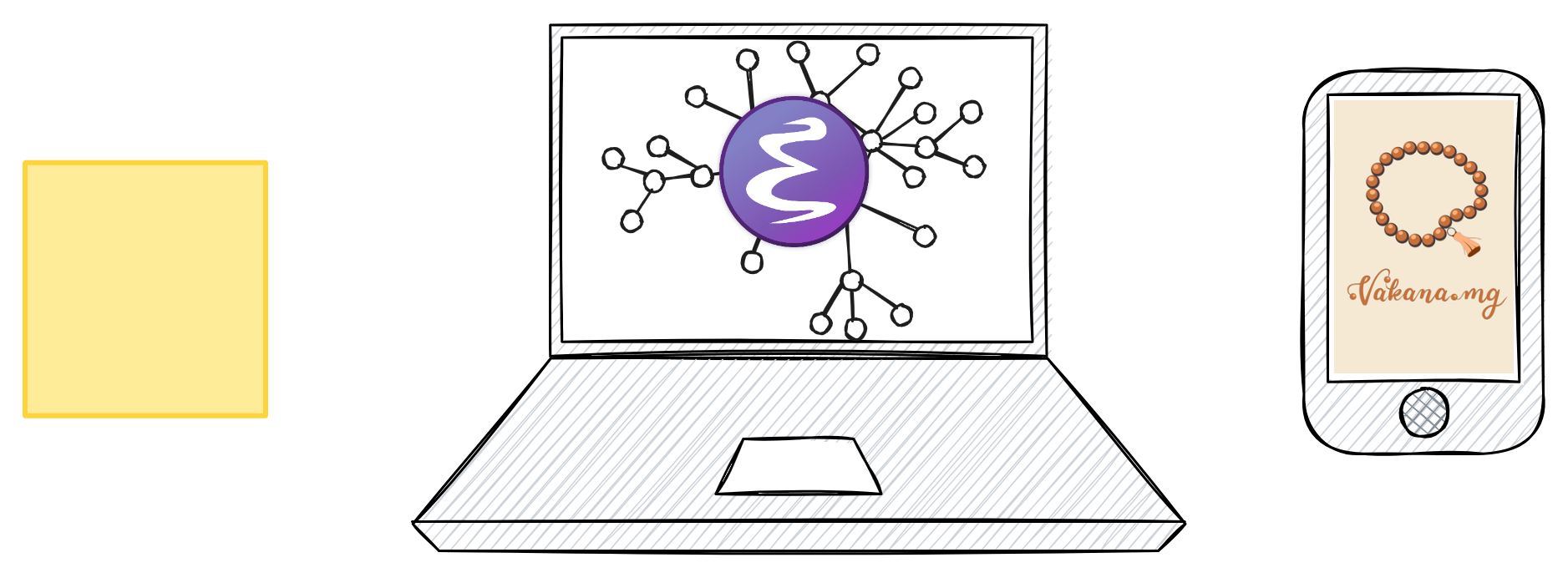
This post is my participation in this month’s Emacs Carnival, on the theme of The Search for Knowledge.
About my current workflow
My way of handling notes and knowledge has evolved a lot over time. I’ve written about my note-taking journey in this blog post.
As of today, my knowledge management sauce is composed of Emacs and Vakana.mg. I’ve been using Logseq less and less over the past few months.
Indoor
In my day-to-day computer usage, I have the Emacs client open all day long with a scratch buffer ready for anything. I dump everything into the scratch buffer, remove or add paragraphs as needed and use vundo for time traveling. I use no structure except some dashes as separation between topics.
Whether it’s to capture fleeting insights or mold prompts for LLMs, the scratch buffer acts as a buffer between my mind and the computer (notes, prompts, etc.).
If something interesting is worth saving, then I save it. I use Denote for that.
If I’m not using my computer, I use pen and paper to capture thoughts and ideas, which I extract later on using a VLM if it’s worth saving. I talk about the process in this post.
Outdoor
For external capture I use Vakana.mg, my own offline mobile app. It solves the problem of taking photos, writing notes and commenting on them at the same time.
Very practical when I’m in the wild documenting plants. When I’m back home, I can export to an Org file from my phone and send it to my computer using LocalSend.
The Search for Knowledge
Retrieving
I don’t bother too much about retrieving. In Emacs, I either just open Denote or use project-find-regexp to reach whatever I want. Vakana.mg’s search also does fuzzy finding inside note contents.
On knowledge graphs
From what I’ve learned and in my own experience, retention of knowledge works better when the owner defines the visual representation of the information to retain, so it matches the way their mind works, and not the other way around (by letting the patterns emerge).
Putting direct intent into the graph’s shape makes the retention of the knowledge stronger. It’s the same mechanism as “charging an image” for better retention in the Memory Palace technique.
Vakana.mg’s visual design works better for me because it’s easier to traverse nodes in a linear way. And custom threads representing specific topics make for clean reading and understanding.
Emacs Packages for Knowledge Management
I like Hyperbole and org-roam but I don’t use them at all. I use Denote and plain org files. The simpler, the better for me. Even the information structure is very simple: one file = one topic. The length may vary.
Where do all my notes come from?
I don’t copy-paste much from other sources. Most of what I write comes from my brain. Either by digesting some books or through insights and observations.
The exceptions are pictures I take with my phone.
What’s next? What I wish to have
Resurfacing random notes.
I write more notes than I can review. A lot of notes are buried forever. In my spare time, I want to be able to go through my old collected notes. I added the feature in Vakana.mg. I don’t have the system in place yet in Emacs.Whiteboard inside Emacs.
Artist mode is really good but it’s not that great for sharing because not everyone is a fan of ASCII art. Especially in a professional context. For that, I rely heavily on Excalidraw for diagrams. Now that we have the Emacs canvas, I really hope someone will soon build something similar to Excalidraw within Emacs.